

PhD Candidates
Syed Rizvi
Forensics and Security Research Group
Syed Rizvi is a PhD candidate in the Forensics and Security Research Group. A fuller biography, research profile, and headshot will be added soon.
Research Output
Publications
- 2025
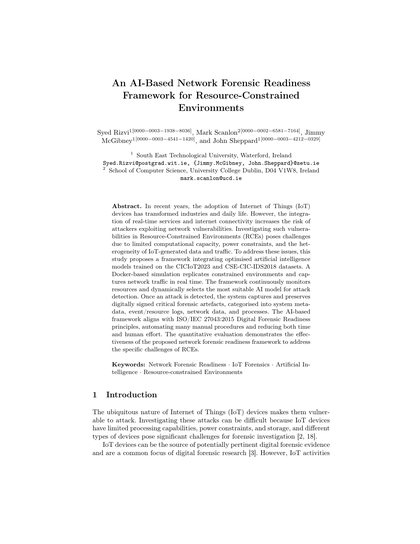 An AI-Based Network Forensic Readiness Framework for Resource-Constrained Environments
Proceedings of the 18th International Workshop on Digital Forensics, part of the 20th International Conference on Availability, Reliability and Security
- 2024
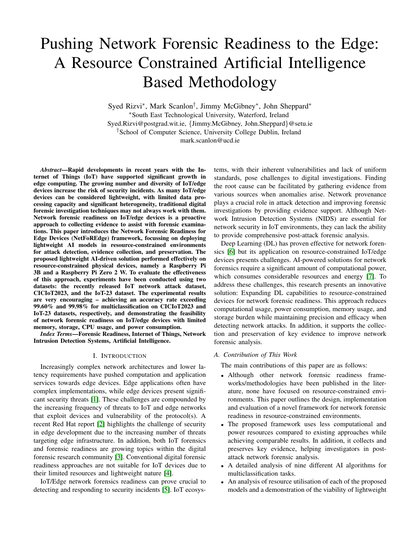 Pushing Network Forensic Readiness to the Edge: A Resource Constrained Artificial Intelligence Based Methodology
2024 Cyber Research Conference - Ireland (Cyber-RCI)
- 2023
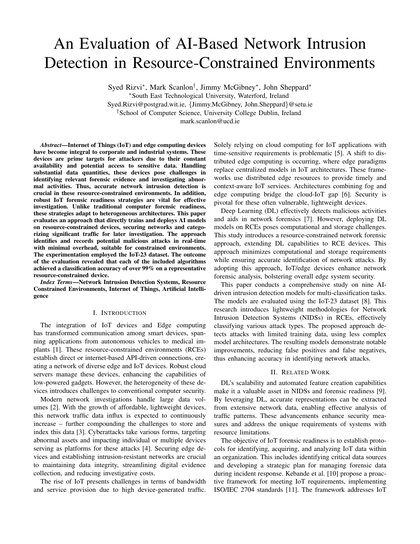 An Evaluation of AI-Based Network Intrusion Detection in Resource-Constrained Environments
14th Annual IEEE Ubiquitous Computing, Electronics & Mobile Communication Conference (IEEE UEMCON)
- 2022
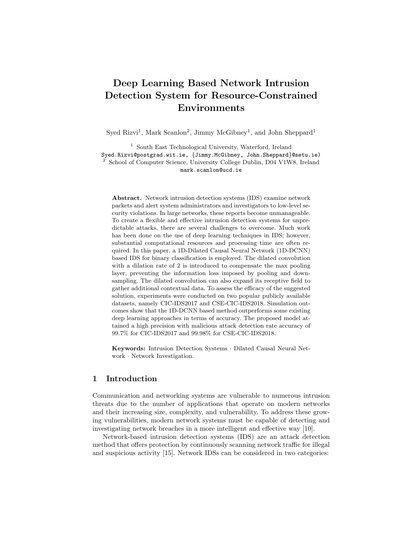 Deep Learning Based Network Intrusion Detection System for Resource-Constrained Environments
The 13th EAI International Conference on Digital Forensics and Cyber Crime
- 2022
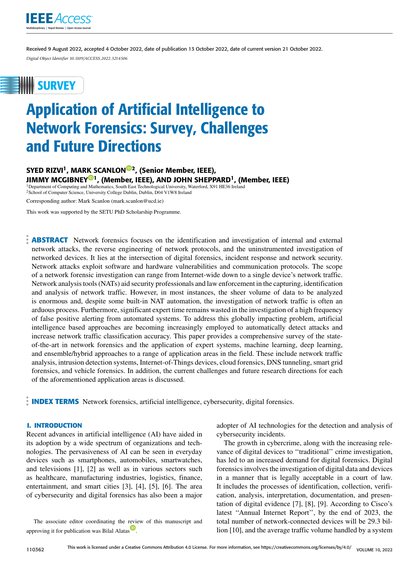 Application of Artificial Intelligence to Network Forensics: Survey, Challenges and Future Directions
IEEE Access Vol. 10 pp. 110362-110384
- 2025An AI-Based Network Forensic Readiness Framework for Resource-Constrained Environments
Proceedings of the 18th International Workshop on Digital Forensics, part of the 20th International Conference on Availability, Reliability and Security
- 2025An AI-Based Network Forensic Readiness Framework for Resource-Constrained Environments
Proceedings of the 18th International Workshop on Digital Forensics, part of the 20th International Conference on Availability, Reliability and Security
- 2023An Evaluation of AI-Based Network Intrusion Detection in Resource-Constrained Environments
14th Annual IEEE Ubiquitous Computing, Electronics & Mobile Communication Conference (IEEE UEMCON)
- 2023An Evaluation of AI-Based Network Intrusion Detection in Resource-Constrained Environments
14th Annual IEEE Ubiquitous Computing, Electronics & Mobile Communication Conference (IEEE UEMCON)
- 2022Application of Artificial Intelligence to Network Forensics: Survey, Challenges and Future Directions
IEEE Access Vol. 10 pp. 110362-110384
- 2022Application of Artificial Intelligence to Network Forensics: Survey, Challenges and Future Directions
IEEE Access Vol. 10 pp. 110362-110384
- 2022Deep Learning Based Network Intrusion Detection System for Resource-Constrained Environments
The 13th EAI International Conference on Digital Forensics and Cyber Crime
- 2022Deep Learning Based Network Intrusion Detection System for Resource-Constrained Environments
The 13th EAI International Conference on Digital Forensics and Cyber Crime
- 2024Pushing Network Forensic Readiness to the Edge: A Resource Constrained Artificial Intelligence Based Methodology
2024 Cyber Research Conference - Ireland (Cyber-RCI)
- 2024Pushing Network Forensic Readiness to the Edge: A Resource Constrained Artificial Intelligence Based Methodology
2024 Cyber Research Conference - Ireland (Cyber-RCI)