

Directors
Dr. John Sheppard
South East Technological University
John Sheppard is Course Leader for the BSc (Hons) in Computer Forensics and Security at South East Technological University (SETU). He holds a BSc and a PhD from University College Dublin.
His research focuses on data mining for intrusion detection, network forensic analysis, and IoT and small-device forensics. In 2019, John was awarded a Fulbright Scholarship to Georgetown University. He teaches modules in file system forensics, network and online forensics, and emerging device forensics.
Research Output
Publications
- 2027
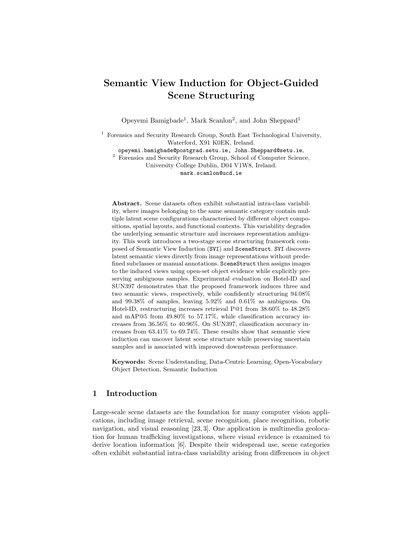 Semantic View Induction for Object-Guided Scene Structuring
Proceedings of the Computer Vision Conference (CVC) 2027
- 2026
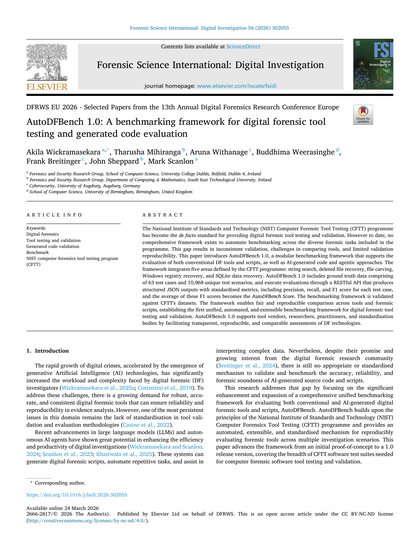 AutoDFBench 1.0: A benchmarking framework for digital forensic tool testing and generated code evaluation
Forensic Science International: Digital Investigation Vol. 56 Article 302055
- 2026
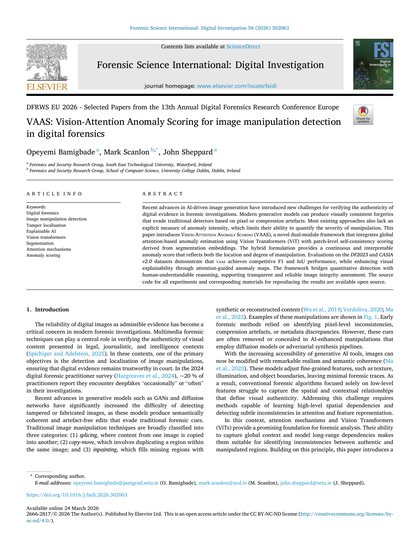 VAAS: Vision-Attention Anomaly Scoring for image manipulation detection in digital forensics
Forensic Science International: Digital Investigation Vol. 56 Article 302063
- 2025
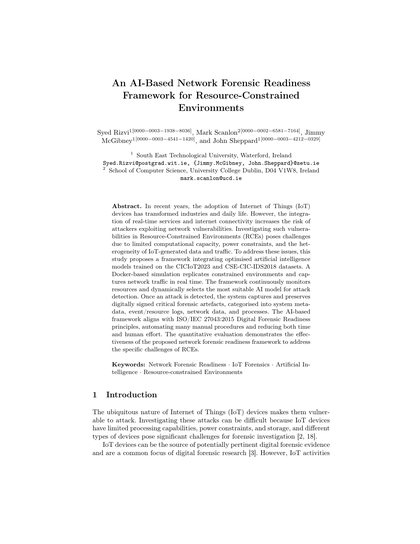 An AI-Based Network Forensic Readiness Framework for Resource-Constrained Environments
Proceedings of the 18th International Workshop on Digital Forensics, part of the 20th International Conference on Availability, Reliability and Security
- 2025
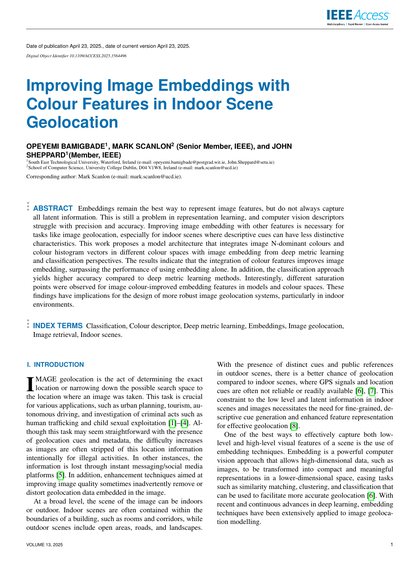 Improving Image Embeddings with Colour Features in Indoor Scene Geolocation
IEEE Access Vol. 13 pp. 79860-79870
- 2024
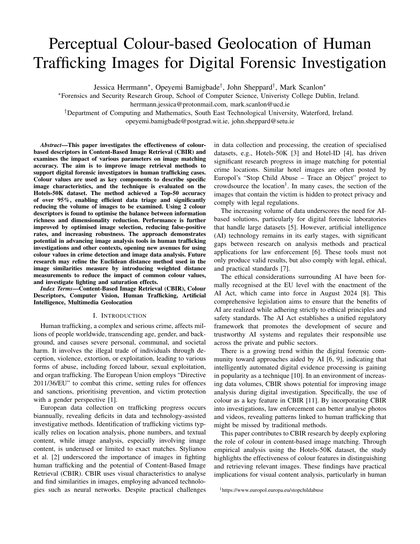 Perceptual Colour-based Geolocation of Human Trafficking Images for Digital Forensic Investigation
2024 Cyber Research Conference - Ireland (Cyber-RCI)
- 2024
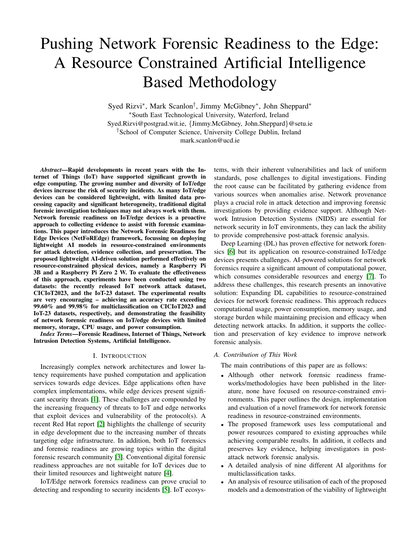 Pushing Network Forensic Readiness to the Edge: A Resource Constrained Artificial Intelligence Based Methodology
2024 Cyber Research Conference - Ireland (Cyber-RCI)
- 2024
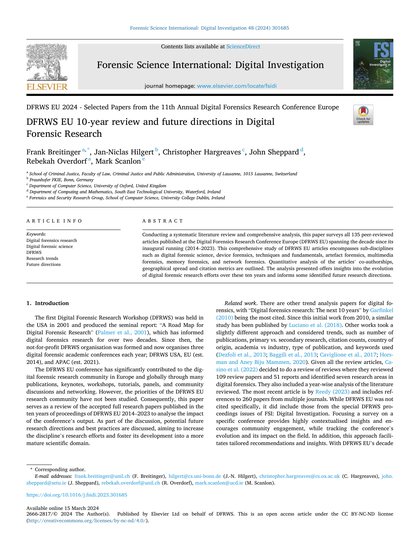 DFRWS EU 10-Year Review and Future Directions in Digital Forensic Research
Forensic Science International: Digital Investigation Vol. 48 Article 301685
- 2023
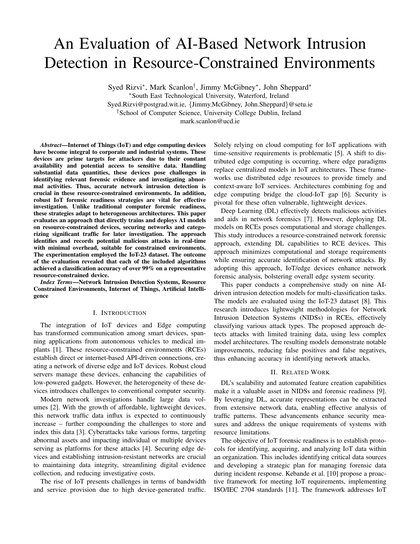 An Evaluation of AI-Based Network Intrusion Detection in Resource-Constrained Environments
14th Annual IEEE Ubiquitous Computing, Electronics & Mobile Communication Conference (IEEE UEMCON)
- 2023
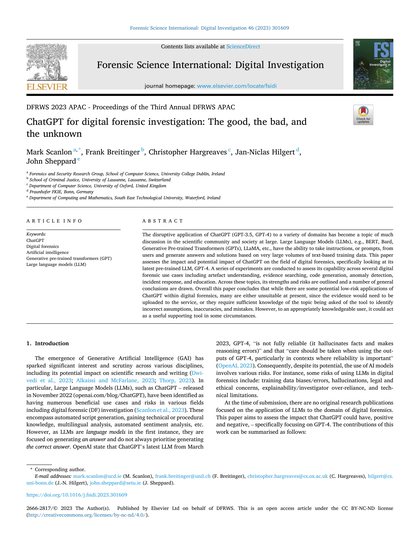 ChatGPT for digital forensic investigation: The good, the bad, and the unknown
Forensic Science International: Digital Investigation Vol. 46 Article 301609
- 2022
 Deep Learning Based Network Intrusion Detection System for Resource-Constrained Environments
The 13th EAI International Conference on Digital Forensics and Cyber Crime
- 2022
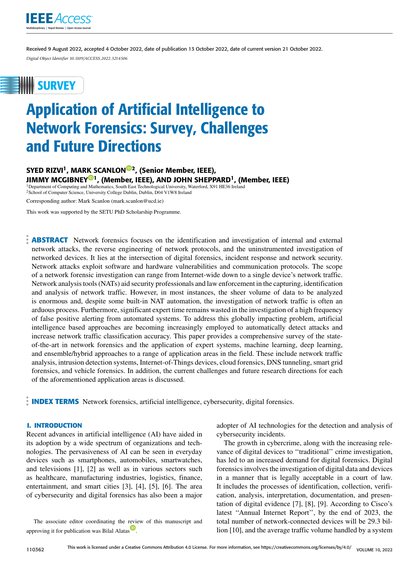 Application of Artificial Intelligence to Network Forensics: Survey, Challenges and Future Directions
IEEE Access Vol. 10 pp. 110362-110384
- 2021
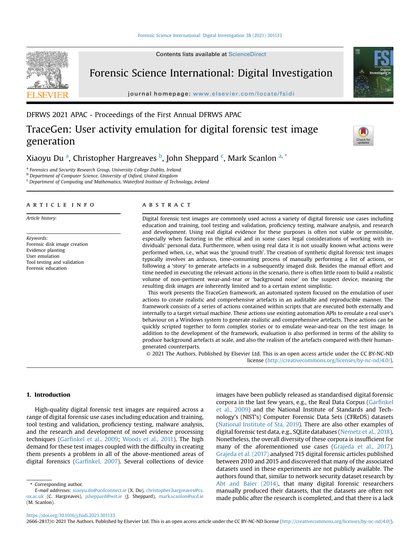 TraceGen: User Activity Emulation for Digital Forensic Test Image Generation
Forensic Science International: Digital Investigation Vol. 38 Article 301133
- 2020
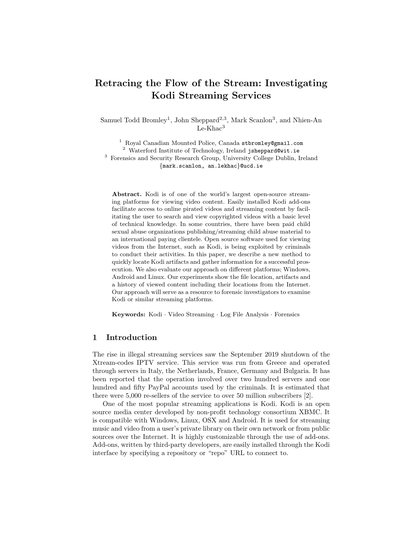 Retracing the Flow of the Stream: Investigating Kodi Streaming Services
The 11th EAI International Conference on Digital Forensics and Cyber Crime
- 2020
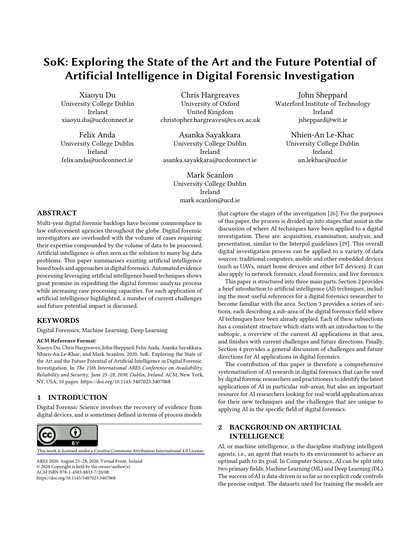 SoK: Exploring the State of the Art and the Future Potential of Artificial Intelligence in Digital Forensic Investigation
The 13th International Workshop on Digital Forensics (WSDF), held at the 15th International Conference on Availability, Reliability and Security (ARES)
- 2018
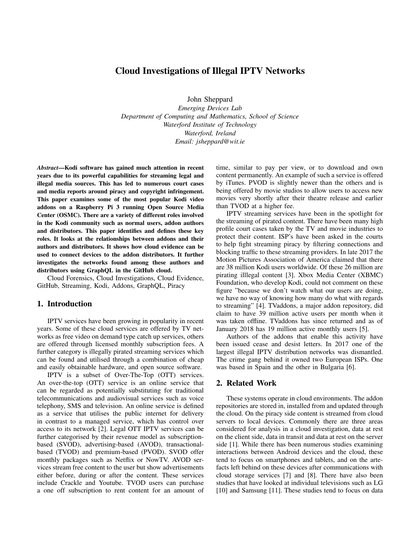 Cloud Investigations of Illegal IPTV Networks
Proceedings of the 17th IEEE International Conference On Trust, Security And Privacy In Computing And Communications (TrustCom-18) pp. 1942-1947
- 2025An AI-Based Network Forensic Readiness Framework for Resource-Constrained Environments
Proceedings of the 18th International Workshop on Digital Forensics, part of the 20th International Conference on Availability, Reliability and Security
- 2025An AI-Based Network Forensic Readiness Framework for Resource-Constrained Environments
Proceedings of the 18th International Workshop on Digital Forensics, part of the 20th International Conference on Availability, Reliability and Security
- 2023An Evaluation of AI-Based Network Intrusion Detection in Resource-Constrained Environments
14th Annual IEEE Ubiquitous Computing, Electronics & Mobile Communication Conference (IEEE UEMCON)
- 2023An Evaluation of AI-Based Network Intrusion Detection in Resource-Constrained Environments
14th Annual IEEE Ubiquitous Computing, Electronics & Mobile Communication Conference (IEEE UEMCON)
- 2022Application of Artificial Intelligence to Network Forensics: Survey, Challenges and Future Directions
IEEE Access Vol. 10 pp. 110362-110384
- 2022Application of Artificial Intelligence to Network Forensics: Survey, Challenges and Future Directions
IEEE Access Vol. 10 pp. 110362-110384
- 2026AutoDFBench 1.0: A benchmarking framework for digital forensic tool testing and generated code evaluation
Forensic Science International: Digital Investigation Vol. 56 Article 302055
- 2026AutoDFBench 1.0: A benchmarking framework for digital forensic tool testing and generated code evaluation
Forensic Science International: Digital Investigation Vol. 56 Article 302055
- 2023ChatGPT for digital forensic investigation: The good, the bad, and the unknown
Forensic Science International: Digital Investigation Vol. 46 Article 301609
- 2023ChatGPT for digital forensic investigation: The good, the bad, and the unknown
Forensic Science International: Digital Investigation Vol. 46 Article 301609
- 2018Cloud Investigations of Illegal IPTV Networks
Proceedings of the 17th IEEE International Conference On Trust, Security And Privacy In Computing And Communications (TrustCom-18) pp. 1942-1947
- 2018Cloud Investigations of Illegal IPTV Networks
Proceedings of the 17th IEEE International Conference On Trust, Security And Privacy In Computing And Communications (TrustCom-18) pp. 1942-1947
- 2022Deep Learning Based Network Intrusion Detection System for Resource-Constrained Environments
The 13th EAI International Conference on Digital Forensics and Cyber Crime
- 2022Deep Learning Based Network Intrusion Detection System for Resource-Constrained Environments
The 13th EAI International Conference on Digital Forensics and Cyber Crime
- 2024DFRWS EU 10-Year Review and Future Directions in Digital Forensic Research
Forensic Science International: Digital Investigation Vol. 48 Article 301685
- 2024DFRWS EU 10-Year Review and Future Directions in Digital Forensic Research
Forensic Science International: Digital Investigation Vol. 48 Article 301685
- 2025Improving Image Embeddings with Colour Features in Indoor Scene Geolocation
IEEE Access Vol. 13 pp. 79860-79870
- 2025Improving Image Embeddings with Colour Features in Indoor Scene Geolocation
IEEE Access Vol. 13 pp. 79860-79870
- 2024Perceptual Colour-based Geolocation of Human Trafficking Images for Digital Forensic Investigation
2024 Cyber Research Conference - Ireland (Cyber-RCI)
- 2024Perceptual Colour-based Geolocation of Human Trafficking Images for Digital Forensic Investigation
2024 Cyber Research Conference - Ireland (Cyber-RCI)
- 2024Pushing Network Forensic Readiness to the Edge: A Resource Constrained Artificial Intelligence Based Methodology
2024 Cyber Research Conference - Ireland (Cyber-RCI)
- 2024Pushing Network Forensic Readiness to the Edge: A Resource Constrained Artificial Intelligence Based Methodology
2024 Cyber Research Conference - Ireland (Cyber-RCI)
- 2020Retracing the Flow of the Stream: Investigating Kodi Streaming Services
The 11th EAI International Conference on Digital Forensics and Cyber Crime
- 2020Retracing the Flow of the Stream: Investigating Kodi Streaming Services
The 11th EAI International Conference on Digital Forensics and Cyber Crime
- 2027Semantic View Induction for Object-Guided Scene Structuring
Proceedings of the Computer Vision Conference (CVC) 2027
- 2027Semantic View Induction for Object-Guided Scene Structuring
Proceedings of the Computer Vision Conference (CVC) 2027
- 2020SoK: Exploring the State of the Art and the Future Potential of Artificial Intelligence in Digital Forensic Investigation
The 13th International Workshop on Digital Forensics (WSDF), held at the 15th International Conference on Availability, Reliability and Security (ARES)
- 2020SoK: Exploring the State of the Art and the Future Potential of Artificial Intelligence in Digital Forensic Investigation
The 13th International Workshop on Digital Forensics (WSDF), held at the 15th International Conference on Availability, Reliability and Security (ARES)
- 2021TraceGen: User Activity Emulation for Digital Forensic Test Image Generation
Forensic Science International: Digital Investigation Vol. 38 Article 301133
- 2021TraceGen: User Activity Emulation for Digital Forensic Test Image Generation
Forensic Science International: Digital Investigation Vol. 38 Article 301133
- 2026VAAS: Vision-Attention Anomaly Scoring for image manipulation detection in digital forensics
Forensic Science International: Digital Investigation Vol. 56 Article 302063
- 2026VAAS: Vision-Attention Anomaly Scoring for image manipulation detection in digital forensics
Forensic Science International: Digital Investigation Vol. 56 Article 302063