

PhD Alumni
Dr. Felix Anda
University College Dublin
Felix Anda completed his PhD in the School of Computer Science, UCD, under the co-supervision of Dr. Mark Scanlon and Dr. Nhien-An Le-Khac.
His PhD research focused on automated, machine learning-based digital evidence classification and identification techniques.
Research Output
Publications
- 2021
- 2021
 Vec2UAge: Enhancing Underage Age Estimation Performance through Facial Embeddings
Forensic Science International: Digital Investigation Vol. 36 Article 301119
- 2020
 SoK: Exploring the State of the Art and the Future Potential of Artificial Intelligence in Digital Forensic Investigation
The 13th International Workshop on Digital Forensics (WSDF), held at the 15th International Conference on Availability, Reliability and Security (ARES)
- 2020
 Assessing the Influencing Factors on the Accuracy of Underage Facial Age Estimation
The 6th IEEE International Conference on Cyber Security and Protection of Digital Services (Cyber Security)
- 2020
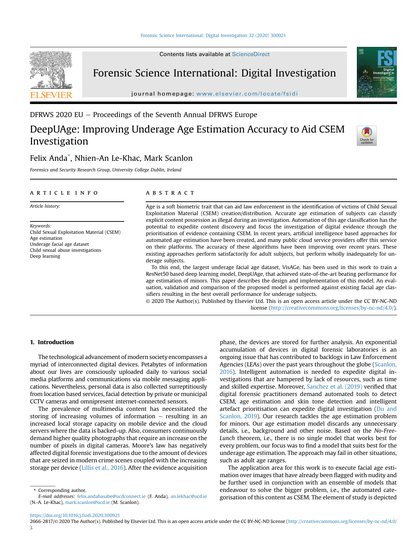 DeepUAge: Improving Underage Age Estimation Accuracy to Aid CSEM Investigation
Forensic Science International: Digital Investigation Vol. 32 Article 300921
- 2019
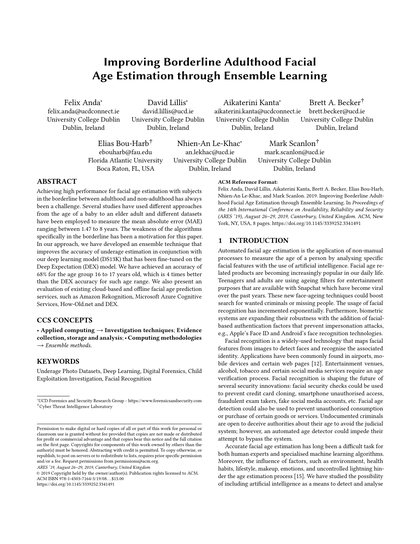 Improving Borderline Adulthood Facial Age Estimation through Ensemble Learning
The 8th International Workshop on Cyber Crime (IWCC), held at the 14th International Conference on Availability, Reliability and Security (ARES)
- 2019
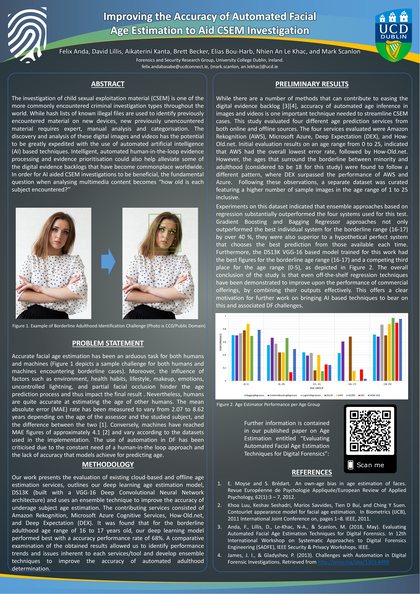 Improving the Accuracy of Automated Facial Age Estimation to Aid CSEM Investigations
Digital Investigation Vol. 28 Article S142
- 2018
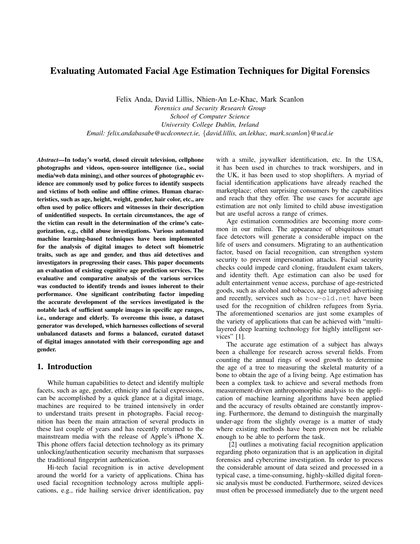 Evaluating Automated Facial Age Estimation Techniques for Digital Forensics
12th International Workshop on Systematic Approaches to Digital Forensics Engineering (SADFE), IEEE Security & Privacy Workshops
- 2020Assessing the Influencing Factors on the Accuracy of Underage Facial Age Estimation
The 6th IEEE International Conference on Cyber Security and Protection of Digital Services (Cyber Security)
- 2020Assessing the Influencing Factors on the Accuracy of Underage Facial Age Estimation
The 6th IEEE International Conference on Cyber Security and Protection of Digital Services (Cyber Security)
- 2020DeepUAge: Improving Underage Age Estimation Accuracy to Aid CSEM Investigation
Forensic Science International: Digital Investigation Vol. 32 Article 300921
- 2020DeepUAge: Improving Underage Age Estimation Accuracy to Aid CSEM Investigation
Forensic Science International: Digital Investigation Vol. 32 Article 300921
- 2021
- 2021
- 2018Evaluating Automated Facial Age Estimation Techniques for Digital Forensics
12th International Workshop on Systematic Approaches to Digital Forensics Engineering (SADFE), IEEE Security & Privacy Workshops
- 2018Evaluating Automated Facial Age Estimation Techniques for Digital Forensics
12th International Workshop on Systematic Approaches to Digital Forensics Engineering (SADFE), IEEE Security & Privacy Workshops
- 2019Improving Borderline Adulthood Facial Age Estimation through Ensemble Learning
The 8th International Workshop on Cyber Crime (IWCC), held at the 14th International Conference on Availability, Reliability and Security (ARES)
- 2019Improving Borderline Adulthood Facial Age Estimation through Ensemble Learning
The 8th International Workshop on Cyber Crime (IWCC), held at the 14th International Conference on Availability, Reliability and Security (ARES)
- 2019Improving the Accuracy of Automated Facial Age Estimation to Aid CSEM Investigations
Digital Investigation Vol. 28 Article S142
- 2019Improving the Accuracy of Automated Facial Age Estimation to Aid CSEM Investigations
Digital Investigation Vol. 28 Article S142
- 2020SoK: Exploring the State of the Art and the Future Potential of Artificial Intelligence in Digital Forensic Investigation
The 13th International Workshop on Digital Forensics (WSDF), held at the 15th International Conference on Availability, Reliability and Security (ARES)
- 2020SoK: Exploring the State of the Art and the Future Potential of Artificial Intelligence in Digital Forensic Investigation
The 13th International Workshop on Digital Forensics (WSDF), held at the 15th International Conference on Availability, Reliability and Security (ARES)
- 2021Vec2UAge: Enhancing Underage Age Estimation Performance through Facial Embeddings
Forensic Science International: Digital Investigation Vol. 36 Article 301119
- 2021Vec2UAge: Enhancing Underage Age Estimation Performance through Facial Embeddings
Forensic Science International: Digital Investigation Vol. 36 Article 301119