

Academics
Dr. Brett Becker
University College Dublin
Brett Becker is an Assistant Professor at University College Dublin in the School of Computer Science, where he also collaborates with the UCD Heterogeneous Computing Laboratory and CeADAR, the Centre for Applied Data Analytics.
He is also the chief maintainer of the Irish Supercomputer List. Brett has published widely in areas including computer science education, high performance computing, and digital forensics.
Research Output
Publications
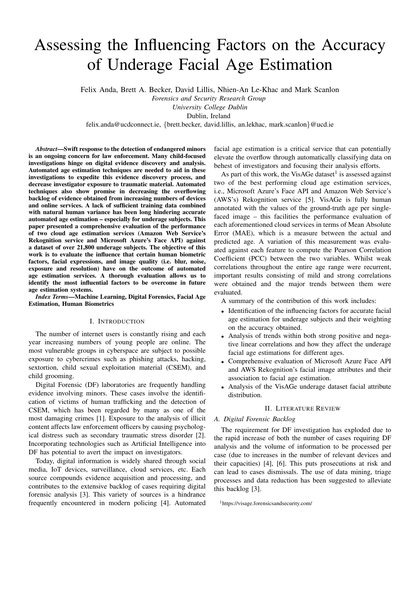
Assessing the Influencing Factors on the Accuracy of Underage Facial Age Estimation
The 6th IEEE International Conference on Cyber Security and Protection of Digital Services (Cyber Security)
This study evaluates the influencing factors on the accuracy of underage facial age estimation using two cloud services, Microsoft Azure's Face API and Amazon Web Service's Rekognition service. The analysis of the VisAGe dataset reveals correlations between facial attributes and age estimation errors, identifying the most significant factors to be addressed in future age estimation modeling.
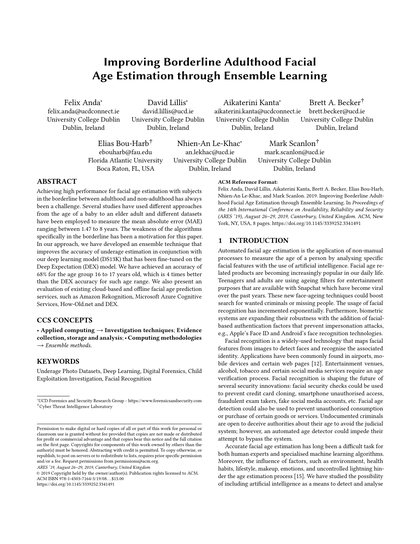
Improving Borderline Adulthood Facial Age Estimation through Ensemble Learning
The 8th International Workshop on Cyber Crime (IWCC), held at the 14th International Conference on Availability, Reliability and Security (ARES)
This paper presents an ensemble learning approach to improve facial age estimation for borderline adulthood cases. The authors develop a deep learning model (DS13K) and fine-tune it on the Deep Expectation (DEX) model to achieve an accuracy of 68% for the age group 16-17 years old, outperforming DEX by 4 times. The study also evaluates existing cloud-based facial age prediction services.
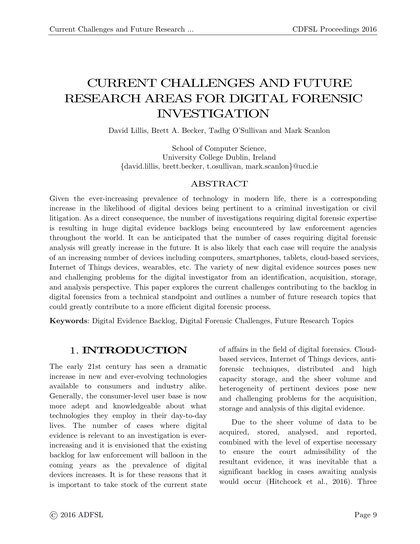
Current Challenges and Future Research Areas for Digital Forensic Investigation
The 11th ADFSL Conference on Digital Forensics, Security and Law (CDFSL 2016) pp. 9-20
This paper explores the current challenges in digital forensic investigations, including the digital evidence backlog, and outlines future research areas to improve the process. The authors discuss the increasing complexity, diversity, and volume of digital evidence, as well as the need for standardization and automation in digital forensic tools and processes.
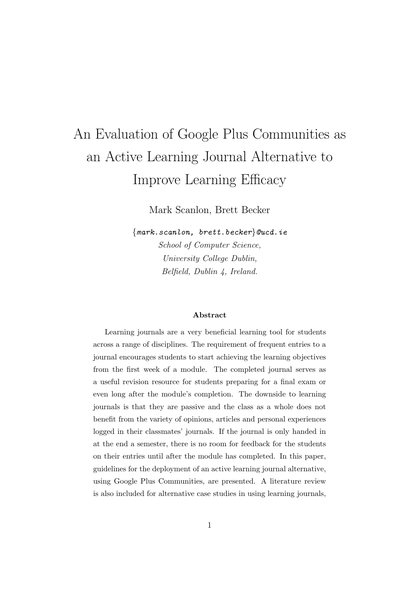
An Evaluation of Google Plus Communities as an Active Learning Journal Alternative to Improve Learning Efficacy
Proceedings of 8th International Conference on Engaging Pedagogy (ICEP 2015)
This study evaluates Google Plus Communities as an active learning journal alternative to improve learning efficacy. The authors present guidelines for deploying G+ Communities in educational settings, highlighting their potential to foster collaborative learning, social interaction, and community engagement.