

PhD Candidates
Akila Wickramasekara
Forensics and Security Research Group
Akila Wickramasekara is a PhD candidate in the Forensics and Security Research Group. A fuller biography, research profile, and headshot will be added soon.
Research Output
Publications
- 2026
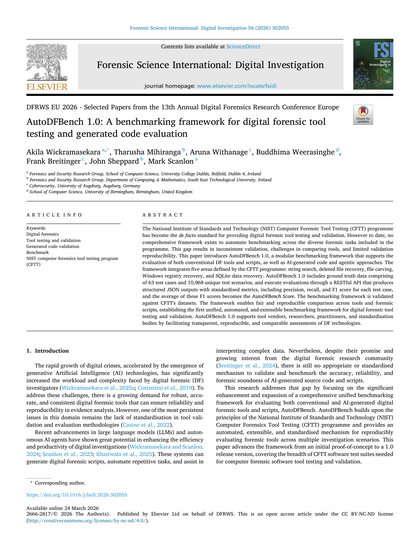 AutoDFBench 1.0: A benchmarking framework for digital forensic tool testing and generated code evaluation
Forensic Science International: Digital Investigation Vol. 56 Article 302055
- 2025
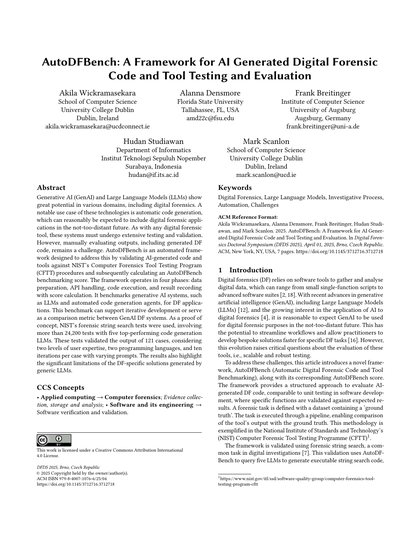 AutoDFBench: A Framework for AI Generated Digital Forensic Code and Tool Testing and Evaluation
Digital Forensics Doctoral Symposium
- 2025
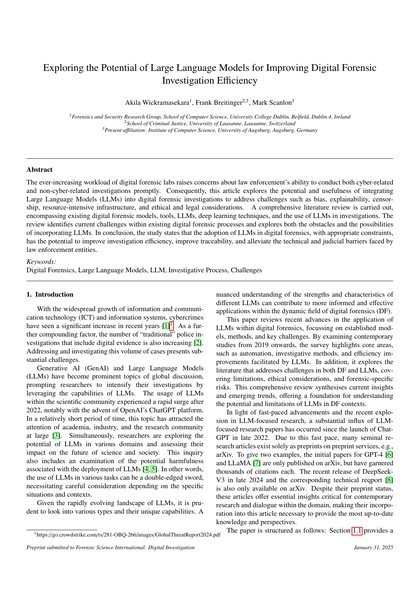 Exploring the Potential of Large Language Models for Improving Digital Forensic Investigation Efficiency
Forensic Science International: Digital Investigation Vol. 52 Article 301859
- 2024
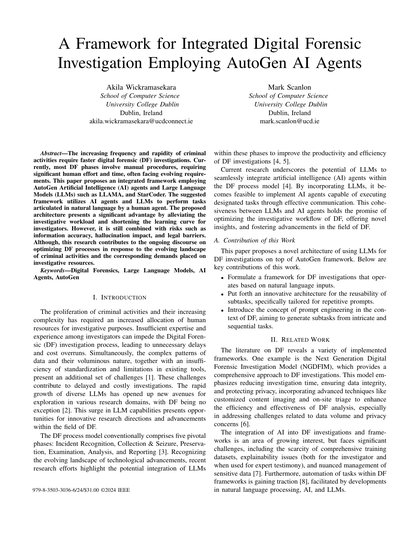 A Framework for Integrated Digital Forensic Investigation Employing AutoGen AI Agents
Proceedings of the 12th International Symposium on Digital Forensics and Security
- 2024A Framework for Integrated Digital Forensic Investigation Employing AutoGen AI Agents
Proceedings of the 12th International Symposium on Digital Forensics and Security
- 2024A Framework for Integrated Digital Forensic Investigation Employing AutoGen AI Agents
Proceedings of the 12th International Symposium on Digital Forensics and Security
- 2026AutoDFBench 1.0: A benchmarking framework for digital forensic tool testing and generated code evaluation
Forensic Science International: Digital Investigation Vol. 56 Article 302055
- 2026AutoDFBench 1.0: A benchmarking framework for digital forensic tool testing and generated code evaluation
Forensic Science International: Digital Investigation Vol. 56 Article 302055
- 2025AutoDFBench: A Framework for AI Generated Digital Forensic Code and Tool Testing and Evaluation
Digital Forensics Doctoral Symposium
- 2025AutoDFBench: A Framework for AI Generated Digital Forensic Code and Tool Testing and Evaluation
Digital Forensics Doctoral Symposium
- 2025Exploring the Potential of Large Language Models for Improving Digital Forensic Investigation Efficiency
Forensic Science International: Digital Investigation Vol. 52 Article 301859
- 2025Exploring the Potential of Large Language Models for Improving Digital Forensic Investigation Efficiency
Forensic Science International: Digital Investigation Vol. 52 Article 301859