

PhD Alumni
Dr. Aikaterini Kanta
University College Dublin
Aikaterini Kanta completed her PhD, Context-Based Password Cracking for Digital Investigation, under the supervision of Assoc. Prof. Mark Scanlon and Dr. Iwen Coisel.
Research Output
Publications
- 2024
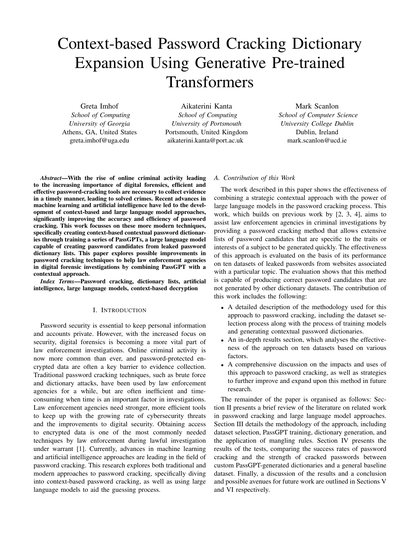 Context Based Password Cracking Dictionary Expansion Using Generative Pre-trained Transformers
2024 Cyber Research Conference - Ireland (Cyber-RCI)
- 2024
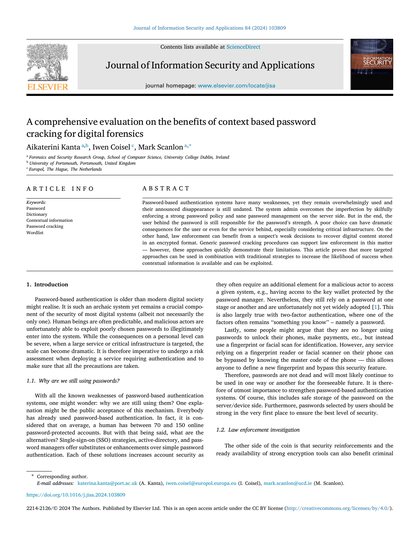 A Comprehensive Evaluation on the Benefits of Context Based Password Cracking for Digital Forensics
Journal of Information Security and Applications Vol. 84 Article 103809
- 2023
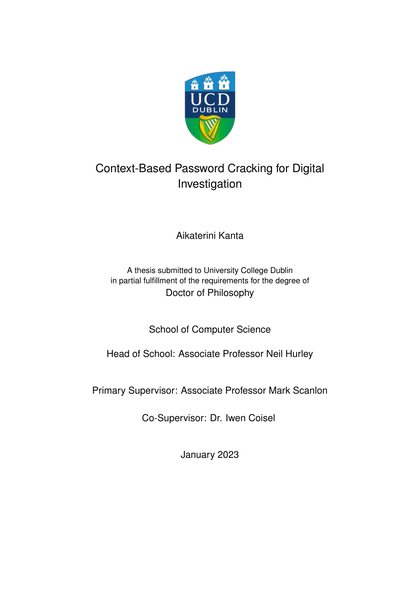 Context-Based Password Cracking for Digital Investigation
University College Dublin
- 2023
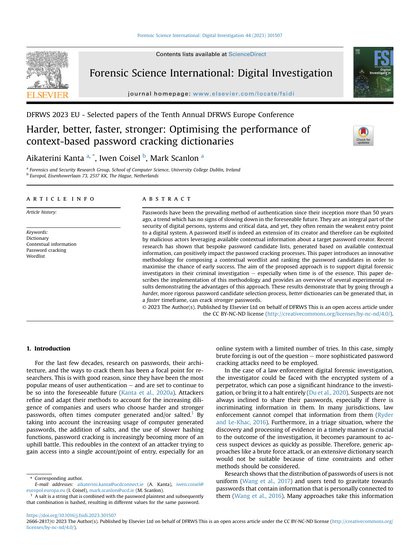 Harder, Better, Faster, Stronger: Optimising the Performance of Context-Based Password Cracking Dictionaries
Forensic Science International: Digital Investigation Vol. 44S Article 301507
- 2022
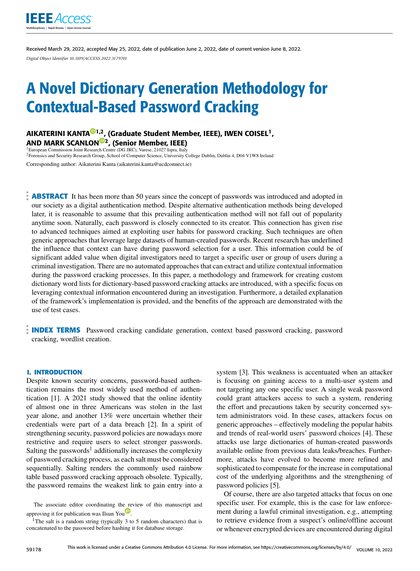 A Novel Dictionary Generation Methodology for Contextual-Based Password Cracking
IEEE Access Vol. 10 pp. 59178-59188
- 2021
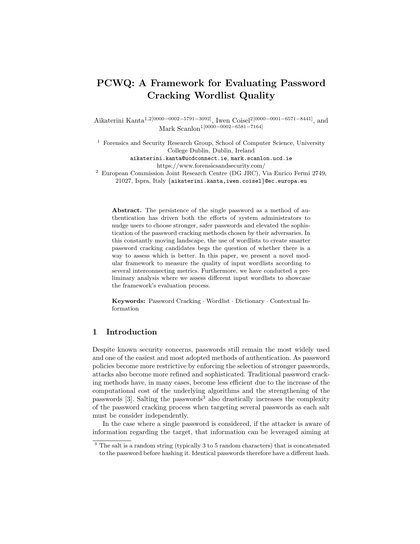 PCWQ: A Framework for Evaluating Password Cracking Wordlist Quality
The 12th EAI International Conference on Digital Forensics and Cyber Crime
- 2021
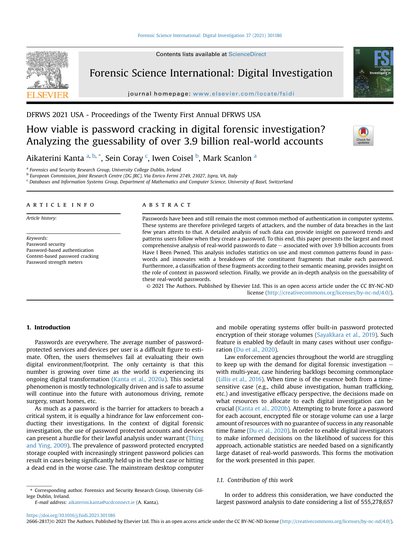 How Viable is Password Cracking in Digital Forensic Investigation? Analyzing the Guessability of over 3.9 Billion Real-World Accounts
Forensic Science International: Digital Investigation Vol. 37 Article 301186
- 2020
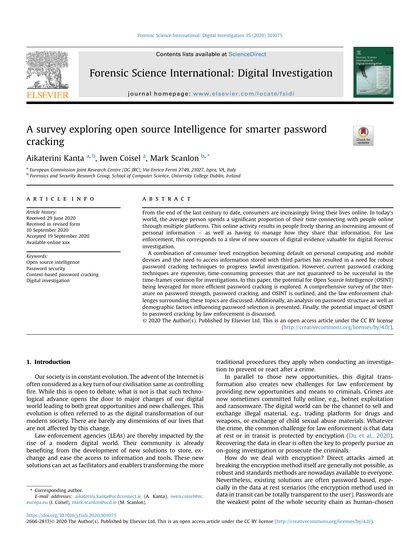 A Survey Exploring Open Source Intelligence for Smarter Password Cracking
Forensic Science International: Digital Investigation Vol. 35 Article 301075
- 2020
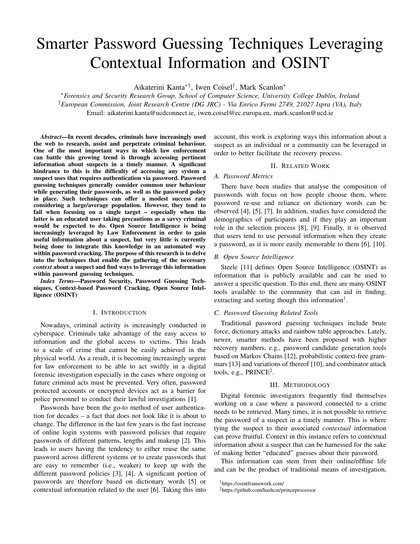 Smarter Password Guessing Techniques Leveraging Contextual Information and OSINT
6th IEEE International Conference on Cyber Security and Protection of Digital Services (Cyber Security)
- 2019
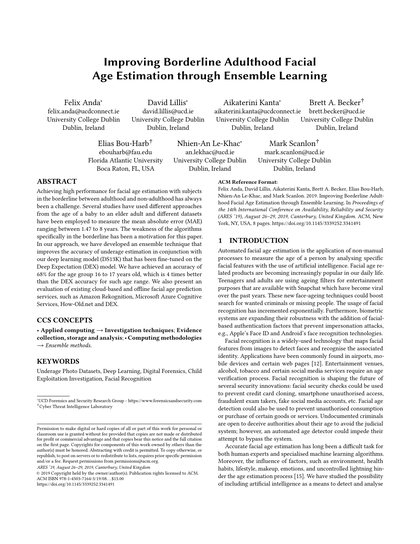 Improving Borderline Adulthood Facial Age Estimation through Ensemble Learning
The 8th International Workshop on Cyber Crime (IWCC), held at the 14th International Conference on Availability, Reliability and Security (ARES)
- 2019
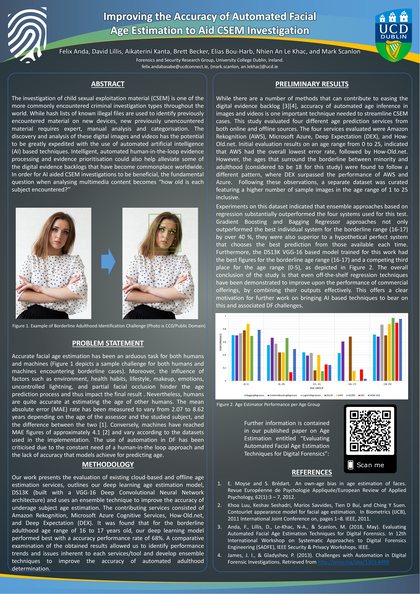 Improving the Accuracy of Automated Facial Age Estimation to Aid CSEM Investigations
Digital Investigation Vol. 28 Article S142
- 2024A Comprehensive Evaluation on the Benefits of Context Based Password Cracking for Digital Forensics
Journal of Information Security and Applications Vol. 84 Article 103809
- 2024A Comprehensive Evaluation on the Benefits of Context Based Password Cracking for Digital Forensics
Journal of Information Security and Applications Vol. 84 Article 103809
- 2022A Novel Dictionary Generation Methodology for Contextual-Based Password Cracking
IEEE Access Vol. 10 pp. 59178-59188
- 2022A Novel Dictionary Generation Methodology for Contextual-Based Password Cracking
IEEE Access Vol. 10 pp. 59178-59188
- 2020A Survey Exploring Open Source Intelligence for Smarter Password Cracking
Forensic Science International: Digital Investigation Vol. 35 Article 301075
- 2020A Survey Exploring Open Source Intelligence for Smarter Password Cracking
Forensic Science International: Digital Investigation Vol. 35 Article 301075
- 2024Context Based Password Cracking Dictionary Expansion Using Generative Pre-trained Transformers
2024 Cyber Research Conference - Ireland (Cyber-RCI)
- 2024Context Based Password Cracking Dictionary Expansion Using Generative Pre-trained Transformers
2024 Cyber Research Conference - Ireland (Cyber-RCI)
- 2023Context-Based Password Cracking for Digital Investigation
University College Dublin
- 2023Context-Based Password Cracking for Digital Investigation
University College Dublin
- 2023Harder, Better, Faster, Stronger: Optimising the Performance of Context-Based Password Cracking Dictionaries
Forensic Science International: Digital Investigation Vol. 44S Article 301507
- 2023Harder, Better, Faster, Stronger: Optimising the Performance of Context-Based Password Cracking Dictionaries
Forensic Science International: Digital Investigation Vol. 44S Article 301507
- 2021How Viable is Password Cracking in Digital Forensic Investigation? Analyzing the Guessability of over 3.9 Billion Real-World Accounts
Forensic Science International: Digital Investigation Vol. 37 Article 301186
- 2021How Viable is Password Cracking in Digital Forensic Investigation? Analyzing the Guessability of over 3.9 Billion Real-World Accounts
Forensic Science International: Digital Investigation Vol. 37 Article 301186
- 2019Improving Borderline Adulthood Facial Age Estimation through Ensemble Learning
The 8th International Workshop on Cyber Crime (IWCC), held at the 14th International Conference on Availability, Reliability and Security (ARES)
- 2019Improving Borderline Adulthood Facial Age Estimation through Ensemble Learning
The 8th International Workshop on Cyber Crime (IWCC), held at the 14th International Conference on Availability, Reliability and Security (ARES)
- 2019Improving the Accuracy of Automated Facial Age Estimation to Aid CSEM Investigations
Digital Investigation Vol. 28 Article S142
- 2019Improving the Accuracy of Automated Facial Age Estimation to Aid CSEM Investigations
Digital Investigation Vol. 28 Article S142
- 2021PCWQ: A Framework for Evaluating Password Cracking Wordlist Quality
The 12th EAI International Conference on Digital Forensics and Cyber Crime
- 2021PCWQ: A Framework for Evaluating Password Cracking Wordlist Quality
The 12th EAI International Conference on Digital Forensics and Cyber Crime
- 2020Smarter Password Guessing Techniques Leveraging Contextual Information and OSINT
6th IEEE International Conference on Cyber Security and Protection of Digital Services (Cyber Security)
- 2020Smarter Password Guessing Techniques Leveraging Contextual Information and OSINT
6th IEEE International Conference on Cyber Security and Protection of Digital Services (Cyber Security)